
4 October 2026
Roofers In Formby And Ainsdale: Pine Needles, Dune Wind And The Big Roofs South Of Southport
Hiring a roofer in Formby or Ainsdale? What pine litter does to gutters and valleys, the Green Lane conservation area and its trees, Freshfield's complicated roofs, and what the work costs.
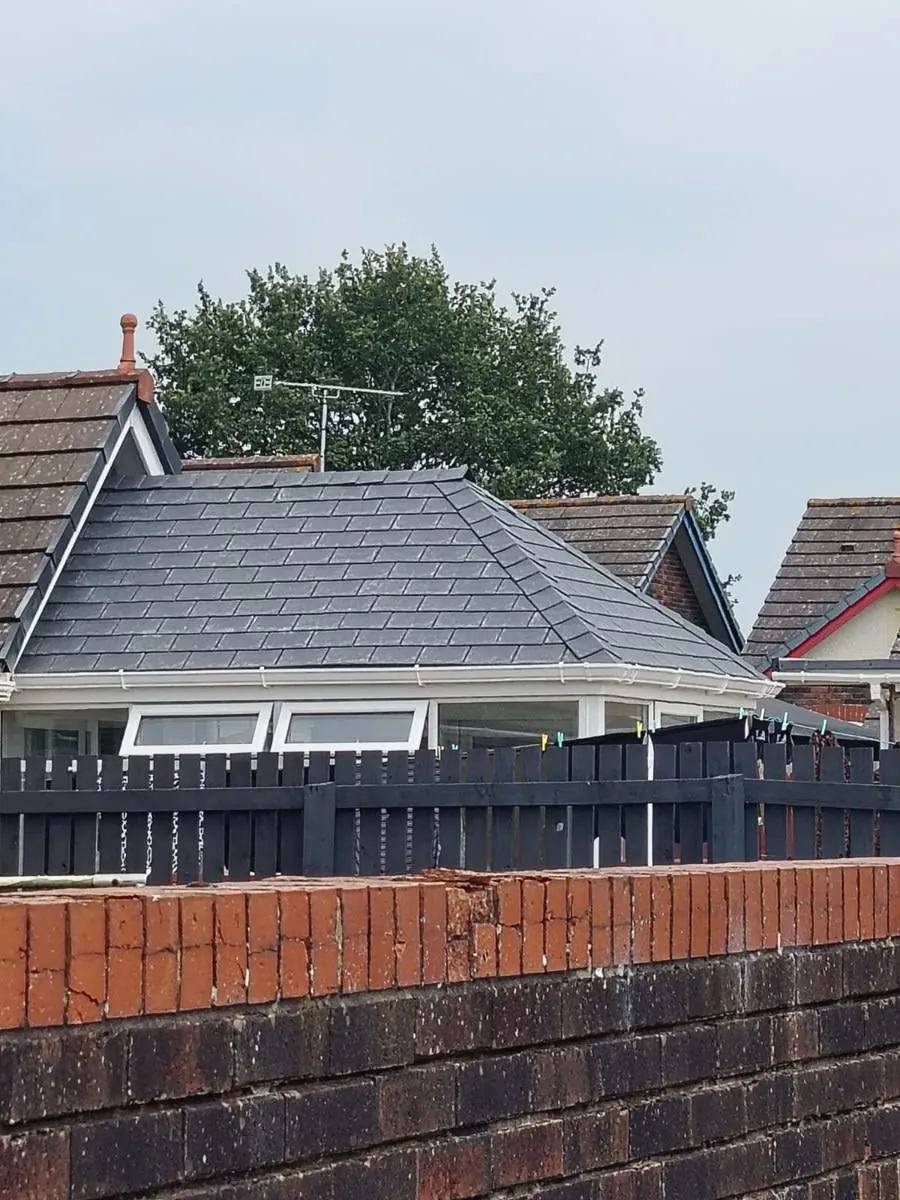
Southport roofers talk about salt and sand so much that you could assume the whole Sefton coast fails the same way. It doesn’t. Drive a few miles south down the A565 and the roofs change their habits. In Ainsdale the bungalows start, and the dunes come right up to the back of the village. Further on, in Formby, the pinewoods take over, and the houses get bigger and more complicated, and they sit under trees that drop something into the gutters every week of the year. Formby has had the same council as Southport since 1974, yet the jobs we’re called to there look nothing like a Birkdale terrace. One conservation area in Freshfield, designated in October 1983, still has a thatched cottage and a house dated 1620 inside it. This guide is for anyone looking for a roofer in Formby or Ainsdale: what goes wrong, what the rules are, roughly what it costs, and how to sort a good quote from a lazy one.
Two villages, one council, very different roofs
Get the paperwork right first, because it’s easy to get wrong. Ainsdale and Formby are both in the Metropolitan Borough of Sefton, so planning and building control for both sit with Sefton Council. Formby has a town council of its own, which confuses people, but it’s a parish body. It gets consulted on applications. It doesn’t decide them.
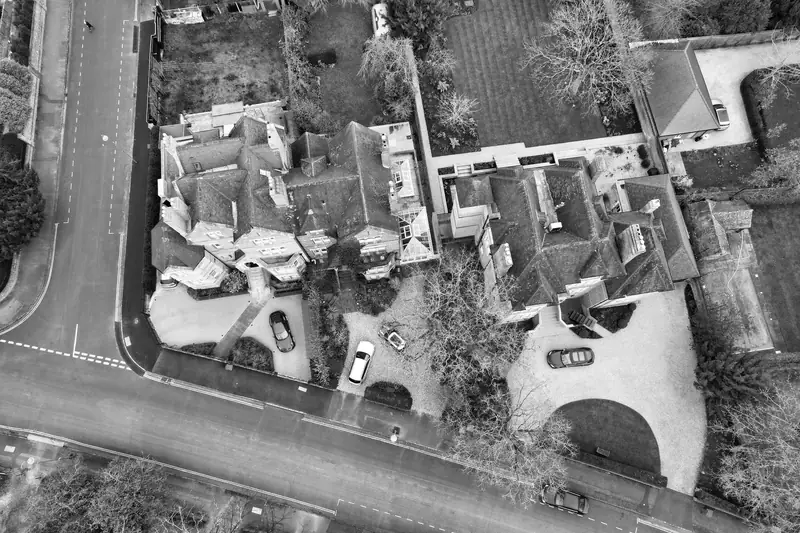
Past that, the two places have little in common. Ainsdale grew between the wars and just after, and a lot of it is low, wide and single-storey, mixed with semis along Liverpool Road and later estates towards Woodvale. Formby, especially Freshfield and the avenues off Victoria Road and Gores Lane, has big detached houses on deep plots with mature trees, most of them pines.
That changes what we get called out for. In Ainsdale it’s usually wind getting under a shallow roof, or sand silting up a gutter. In Formby it’s mostly drainage: gutters, downpipes and valleys choked with tree litter, which is why our guttering work in Formby outnumbers every other job we do there.
Pine needles don’t behave like leaves

Oak and sycamore leaves fall in one go each autumn. You clear the gutters in November and you’re done until next year. Pines shed all year. Every gale brings down another batch of needles and a few cones, and a Formby gutter that was clean in October can be half full by February.
The needles also behave differently once they land. A soggy leaf rots down into sludge you can scoop out. Pine needles knit together into a springy mat that lets a little water through and holds back most of it. It decays slowly, so moss gets a foothold in it. The water that can’t get past runs over the front edge of the gutter and down the wall, and that’s how we end up looking at damp in a Formby bedroom that has nothing wrong with its roof.
Valleys suffer more than gutters. On a hip-and-valley roof, needles slide down the slopes and collect in the valley, where they build a little dam. Rain backs up behind it, finds the edges of the valley lining and gets in. Cones cause a separate problem: they wedge in the swan-neck bend at the top of a downpipe, so the pipe looks fine from the ground while the gutter above it fills up.
A word on gutter guards, because every Formby homeowner asks. Fine mesh and clip-on grilles tend to make pine litter worse. Needles poke through the holes and stick there, and now there’s a guard to take off before anyone can clean the gutter. Brush guards, the ones that look like a long bottle brush lying in the gutter, work much better under pines. They’re still not fit-and-forget.
Wind, sand and the houses nearest the dunes
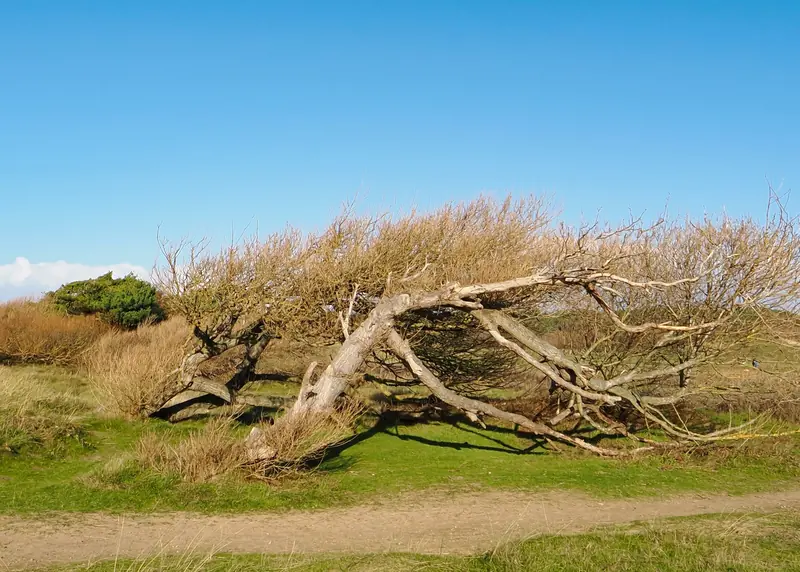
The pines give a lot of Formby some shelter. The houses at the seaward edge don’t get any. Out towards Formby Point, along Lifeboat Road and at the top end of Ainsdale-on-Sea around Shore Road, there’s nothing between the roof and the Irish Sea except dune grass. Trees on the dunes grow bent sideways for the same reason.
Those houses get the westerlies at full strength, with sand in them. Most of what that means for upkeep is already covered in our guide to yearly maintenance on a Sefton coast roof, so we won’t go through it again here. Two things are worth adding for these particular streets. Flat roofs on garage links and dormers collect blown sand around their outlets, which then block the first time it rains hard. And the dry verge and ridge systems put on during 1990s and 2000s re-roofs are the parts that lift first on an exposed gable, so they’re the first thing we check after a named storm.
Further inland, behind the trees and the railway, the wind eases off a good deal. A house off Altcar Road doesn’t take the same beating as one by the National Trust car park, and a roofer who quotes them as if they did hasn’t been to look.
Freshfield’s big roofs, and Ainsdale’s mix
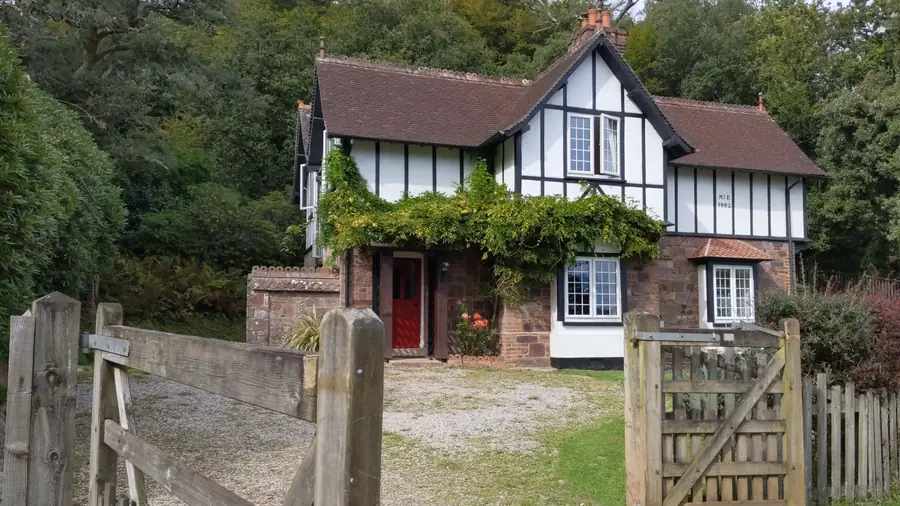
A Formby roof is bigger than a Southport one, and it has more parts. Plenty of the interwar and postwar detached houses have a main hipped roof, a front gable or two with mock-Tudor boarding, dormers added in a loft conversion decades later, and a flat-roofed garage or side link where the house was extended. A conservatory is often tucked in at the back as well. Each of those means another junction, valley or flashing, and those are the places water gets in.
So pricing a repair on one of these houses takes longer. A good roofer will want to see every valley, look at the flat sections from above, and work out how to reach the back without putting a ladder on the conservatory. Access often costs more than the repair. Side passages are narrow, the gardens have mature beds in them, and a tower scaffold sometimes has to come round the back in pieces.
Ainsdale is easier to reach and harder to generalise about. The bungalows have their own set of problems, which we went through in our post on Southport’s bungalow roofs. The two-storey semis around Liverpool Road and Sandbrook Road mostly need the same mid-life work as semis anywhere on this coast: ridge re-bedding, the odd slipped tile, gutters. The newer estates towards Woodvale are only just reaching the age when dry-fix clips start breaking.
Green Lane conservation area and the trees you can’t just lop
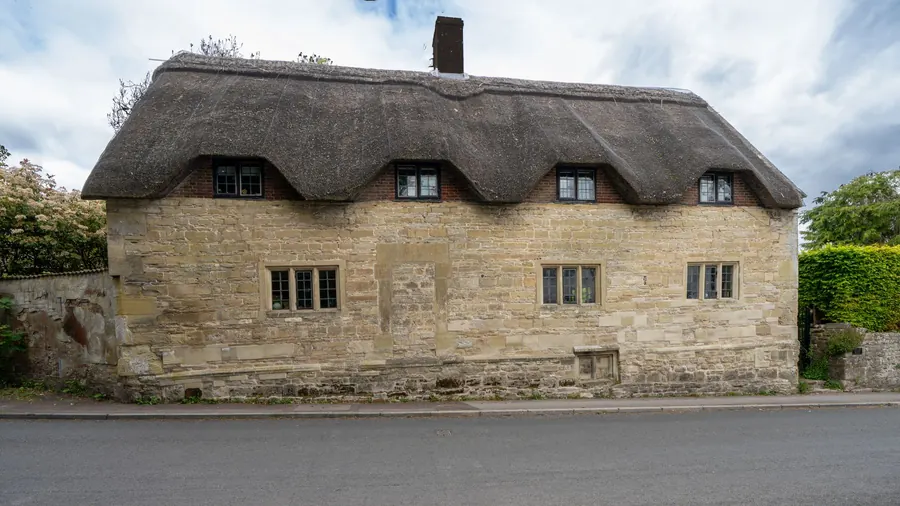
Formby’s conservation area is small and easy to miss. It runs along the southern half of Green Lane in Freshfield, between Gores Lane and Paradise Lane, roughly a kilometre north of the village centre. Sefton designated it in 1983 and adopted a new appraisal in November 2023. The listed buildings inside it include St Peter’s Church, from 1746, May Cottage, with a date of 1620 inside its brickwork, and the thatched cottage at 21 Green Lane. According to Sefton’s Green Lane conservation area appraisal, slate is the main roof covering there, and that thatch is the only exception.
The appraisal looked at an Article 4 direction and chose not to adopt one. Like-for-like roof repairs on a house in Green Lane don’t need special permission. If you’re thinking of changing the material on a roof facing the street, have a word with Sefton’s conservation team first. Listed buildings follow their own rules entirely.
The trees catch people out more often than the buildings do. Many in the area are protected by its conservation status rather than by individual orders, and the appraisal says Tree Preservation Orders are common towards Timms Lane and Victoria Road. Under the government’s guidance on trees in conservation areas, you have to give the council six weeks’ notice before cutting back any tree there with a trunk over 7.5cm across. So a pine branch scraping the gutter isn’t something a roofer can trim on the day. Sort the notice first, then book the gutter work for after the six weeks are up.
What roof work costs in Formby and Ainsdale
We charge the same here as in Southport. Formby is about twenty minutes from us and Ainsdale about ten, so travel doesn’t change the price. The building does.
Here are the figures that come up most often south of Southport. Clearing gutters on a semi, with the downpipes and the gully, runs £90 to £180. A big Formby detached costs more because there’s more gutter and more of it is high up. Clearing a valley and relining it is £400 to £900, and more if the boards under the lining have rotted, which is common under a valley that’s been full of wet needles for years. A patch repair to a flat-roofed garage link is £180 to £500. Re-covering one in EPDM, with the falls rebuilt so water actually drains off, is £1,200 to £2,800. Replacing the fascias, soffits and gutters on a detached house usually costs £2,000 to £4,000.
A slipped tile or slate on its own is £150 to £280 if a ladder can reach it safely. On a Freshfield roof, what pushes a quote up is how much scaffolding or tower the job needs, not the fault. If a quote doesn’t show access as its own line, ask what’s been allowed for.
Picking a roofer for a house under the pines

The general checks are the same anywhere: insurance, a proper address, written guarantees. Our guide on choosing a roofer in Southport goes through them. For a Formby or Ainsdale house, a few questions show quickly whether someone knows the area.
Ask how often they’d clear your gutters, and why. Under mature pines the honest answer is usually twice a year, and on an open Ainsdale bungalow it’s probably once. If they give the same answer for both, they haven’t thought about it. Ask whether they’ll check the valleys or only the gutters. Ask what they’d do about a branch touching the roof, and listen for whether they mention a tree notice. And ask to see the flat roofs from above, in photos, because nobody gets a proper look at a garage link from the drive.
Trade scheme membership is worth checking too, though it won’t answer any of those questions for you. TrustMark, the government-endorsed quality scheme, lets you check whether a firm has really been vetted rather than just using a logo. If you’re further inland, around Ormskirk or Burscough, the roofs fail for different reasons and we covered them separately in our post on Ormskirk and Burscough roofs.
Frequently Asked Questions
Is Formby covered by Sefton Council or its own council for roof work?
Sefton Council handles planning and building control for Formby, exactly as it does for Ainsdale and Southport. Formby also has a town council, but that is a parish-level body that gets consulted on applications rather than deciding them. If your roof work needs any kind of approval, the application goes to Sefton at Bootle. Notices about protected trees go to Sefton as well.
Do I need permission to cut back a pine tree that hangs over my roof in Formby?
Possibly. If the tree has a Tree Preservation Order on it, you need Sefton's consent before pruning. If it stands inside the Green Lane conservation area in Freshfield and has a trunk over 7.5cm across at 1.5 metres above the ground, you have to give the council six weeks' written notice before any work, even without an order. Plenty of pines around Victoria Road and Timms Lane are covered one way or the other. Check before the saw comes out, not after.
Are gutter guards worth fitting under pine trees?
Brush-type guards are, mostly. Pine needles are thin and stiff enough to thread straight through a lot of mesh and clip-on grilles, where they lodge and make cleaning harder than an open gutter. A brush guard sitting in the gutter catches needles on top where the wind can take them off, though it still needs lifting out and shaking every year or so. No guard does anything about cones in a downpipe or needles packed into a roof valley.
How much does a roofer charge for gutter clearing in Formby?
Our gutter clearing starts at £90 to £180 for a semi, including the downpipes and the gully at the bottom. A large Freshfield detached with a conservatory, a garage link and gutters at two heights sits higher than that, because there is more run and more of it needs a longer ladder or a tower. Clearing and relining a needle-choked valley is a separate job, usually £400 to £900.
Free Roof Survey & Quote
Free roof survey and a fixed written quote, anywhere across Southport, Sefton and West Lancashire.