
2 October 2026
Roofers In Ormskirk And Burscough: Inland From The Coast, A Different Council And A Different Kind Of Roof
Ten miles inland from Southport the salt stops mattering and West Lancashire Borough Council takes over. What Ormskirk and Burscough roofs actually fail from, and what a repair costs there.
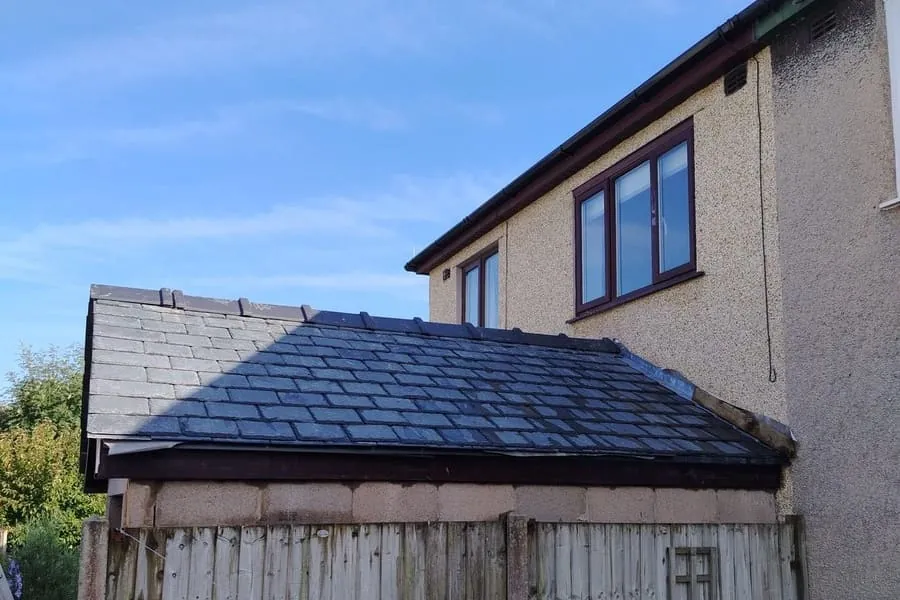
Drive out of Southport on the A570, past Scarisbrick and the garden centres, and somewhere around the Ormskirk bypass two things change without anybody telling you. The salt in the air gives up, and the council does. Ormskirk and Burscough are West Lancashire Borough Council, not Sefton, and they are far enough from the beach that the sand and corrosion that shape most of what we write about on this site simply stop being the story.
That matters because the advice does not transfer. West Lancashire has 28 conservation areas against Sefton’s 25, and its planning department has been noticeably keener on Article 4 directions. Ormskirk has held a market under royal charter since 1286, and its centre still has the tight burgage plots and tall brick frontages to prove it. Burscough is a canal village that grew an airfield, then a commuter belt, and is now growing a new estate on its northern edge. A roofer who treats either of them as Southport-with-fields will quote wrong, plan wrong, and quite possibly diagnose wrong.
Ten miles inland, the sea stops being the problem
On a roof in Birkdale, the first thing we check is the fixings, because salt gets into nails and brackets and eats them from the inside. On a roof in Aughton, we barely glance at them. The prevailing westerlies still arrive, and Ormskirk sits on a low ridge that catches more of them than the flat land around it, but the air has dropped most of its salt by the time it gets there, and there is no dune system upwind to fill the valleys with sand.
So what fails instead? Age, mostly. The roofs around Ormskirk and Burscough fail from being old in the ordinary way: battens that have gone soft, lead that has fatigued and cracked along the fold, mortar that has crumbled off a ridge, slates that have slipped because the nails holding them finally rusted through after a century rather than a decade. It is slower and easier to predict than coastal failure. The fix is usually a smaller job than a Southport customer with the same symptoms would need.
The other thing that moves inland is the direction a roof fails from. On the coast the seaward slope goes first. In Ormskirk the north-facing slope goes first, and the reason is moss.
A tower, a spire and twenty-eight conservation areas
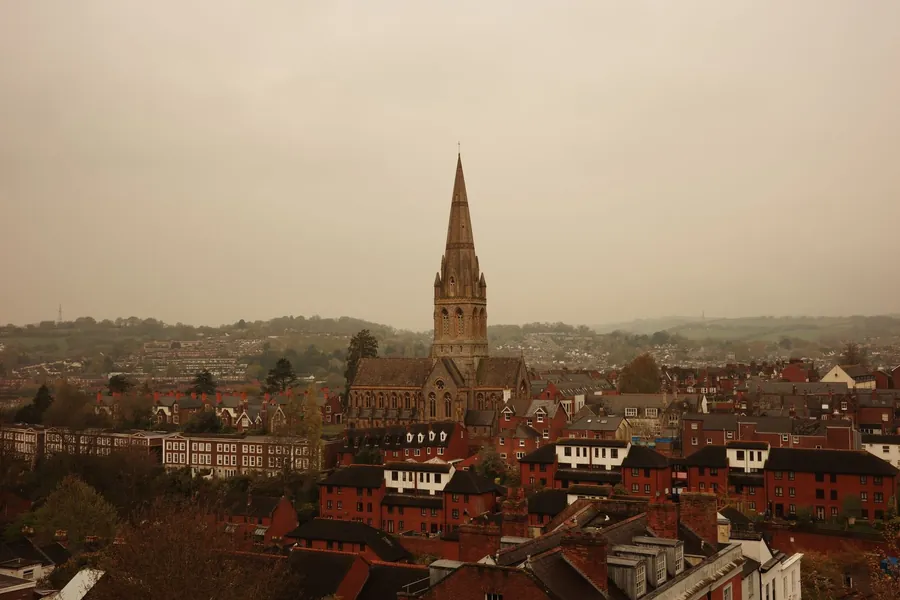
Ormskirk’s parish church is one of a tiny handful in England with both a tower and a spire, standing side by side at the same end of the building. Local legend blames two sisters who could not agree. The usual historical explanation is duller: the tower went up in the sixteenth century to house bells brought from Burscough Priory after the Dissolution, and nobody saw a reason to pull the spire down to make room. Either way, it is the thing you see across the rooftops from almost anywhere in town, and the roofscape around it is what the conservation area was designated to keep.
That designation has teeth here in a way Southport’s do not. The Ormskirk Town Centre conservation area carries an Article 4(2) direction, as do Ruff Lane in Ormskirk, Junction Lane in Burscough, and the Granville Park, Holt Green and St Michael’s Church areas in Aughton. Under the direction, planning permission is needed for alterations to roofs and chimneys on elevations that face a highway or public open space - and the council’s own wording includes a change of material. West Lancashire’s conservation area pages list every designation, with maps showing exactly which frontages the directions cover.
What that means in practice is narrower than people fear. Stripping a slate roof and putting slate back is repair, and nobody at Derby Street wants a form for it. Re-dressing lead, re-bedding a ridge, renewing the battens underneath - none of that touches the appearance. The application is triggered by the things you would notice from the pavement: concrete interlocking tiles replacing Welsh slate on a Church Street frontage, a front chimney coming down, a rooflight appearing in the slope that faces the market. The Planning Portal’s guidance on roof work sets out the national baseline; the Article 4 direction is what removes it on those particular streets.
Welsh slate, north slopes and the moss that grows where the salt does not
The older stock in both towns is red brick, Victorian and Edwardian, and nearly all of it was roofed in Welsh slate. The terraces running off Aughton Street and Burscough Street, the bigger villas along Ruff Lane and out towards Aughton, the rows by Burscough Bridge station - slate on timber battens, with lime mortar torching underneath and no felt at all on the earlier ones.
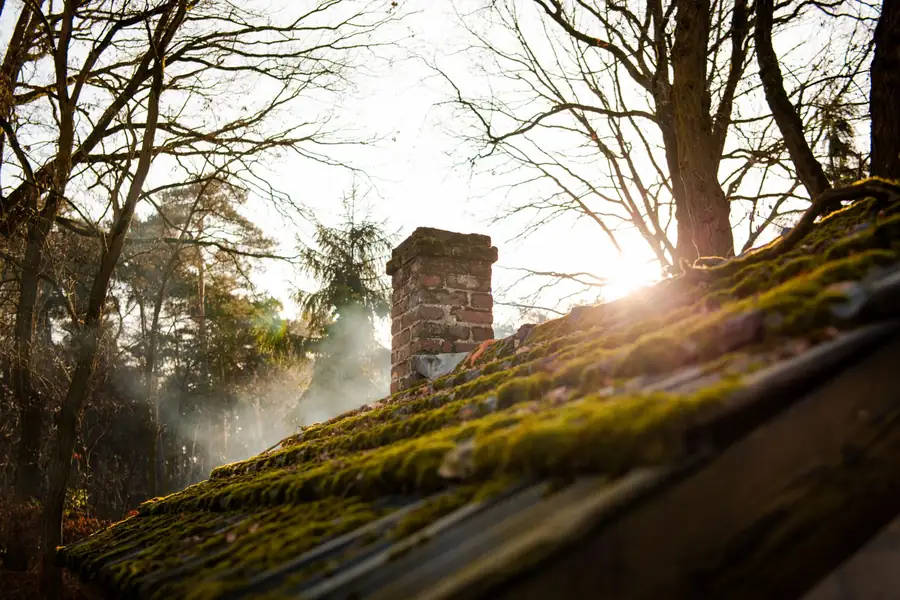
Welsh slate lasts. A hundred and twenty years in, most of it is still sound, and the roof fails around it: the nails, the battens, the lead. But inland, with no salt wind to scour the surface, the slate on a north-facing slope picks up a coat of moss that a coastal roof never manages. Moss holds water. Water sits against the slate through a frost, lifts the surface in flakes, and sits against the nail heads for weeks at a time. Then clumps of it break loose and go down the downpipe, where they stop in the first bend and the gutter overflows down the wall below.
It is why we tell Ormskirk customers something different from what we tell Southport ones. Southport roofs need the sand out of the gutters twice a year. Ormskirk roofs need the moss off the north slope, carefully, by hand, every few years - never jet-washed, which drives water under the slates and takes the surface off them. And when the roof does come to be stripped, the right answer on a conservation-area frontage is slate again, not the concrete tile that was the easy sell in the 1980s. Plenty of older roofs in both towns are still sagging under that decision, carrying twice the weight the rafters were cut for.
Roofs that nobody lives under in the summer
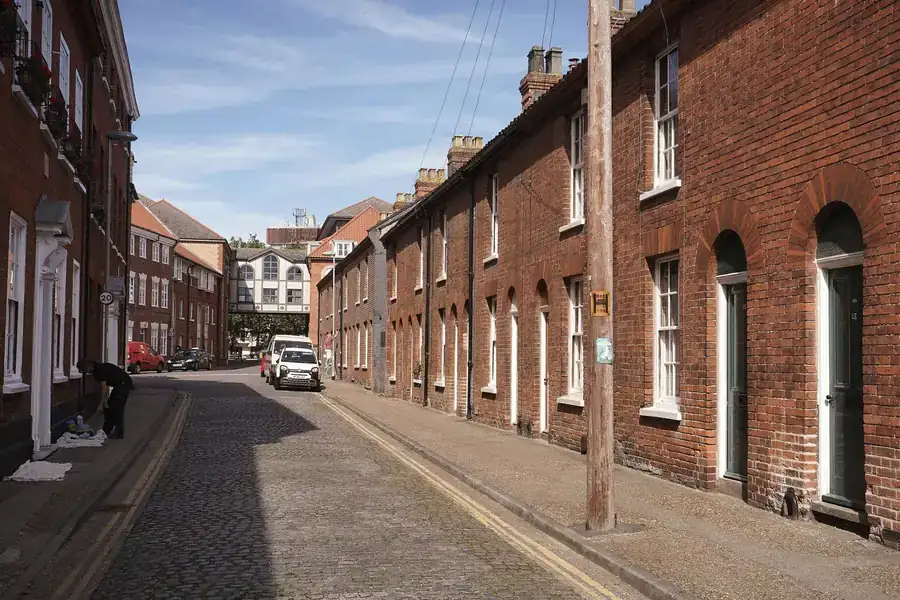
Edge Hill University sits on the south-eastern edge of Ormskirk, and over the past twenty years it has converted a good share of the town’s Victorian terraces into student houses. Three, four, five or six people under a roof that was built for a family of similar size but with very different habits: more showers, more kettles, more drying washing indoors, and nobody in the house at all from June to September.
That combination produces its own pattern of roof trouble, and we see it every autumn. Moisture from below finds its way into a cold loft and condenses on the underside of the slates, which is routinely mistaken for a leak. A genuine leak, meanwhile, starts in May, drips unseen through the summer onto a bedroom ceiling nobody is sleeping under, and is discovered in late September when the new tenants move in and the ceiling comes down. By then it is an insurance claim rather than a slipped slate.
For landlords this is the whole game. We wrote about what the law expects of a landlord’s roof and the detail applies in West Lancashire exactly as it does in Sefton. The practical version for an Ormskirk HMO is simpler: have the roof looked at in July, while the house is empty and a scaffold or ladder can go up without anybody’s bike in the way, and fix what is found before the autumn intake. A written report with photographs, dated and kept, is worth more at a licensing inspection than anything else we can hand you.
Burscough: the canal, the airfield and the estates in between
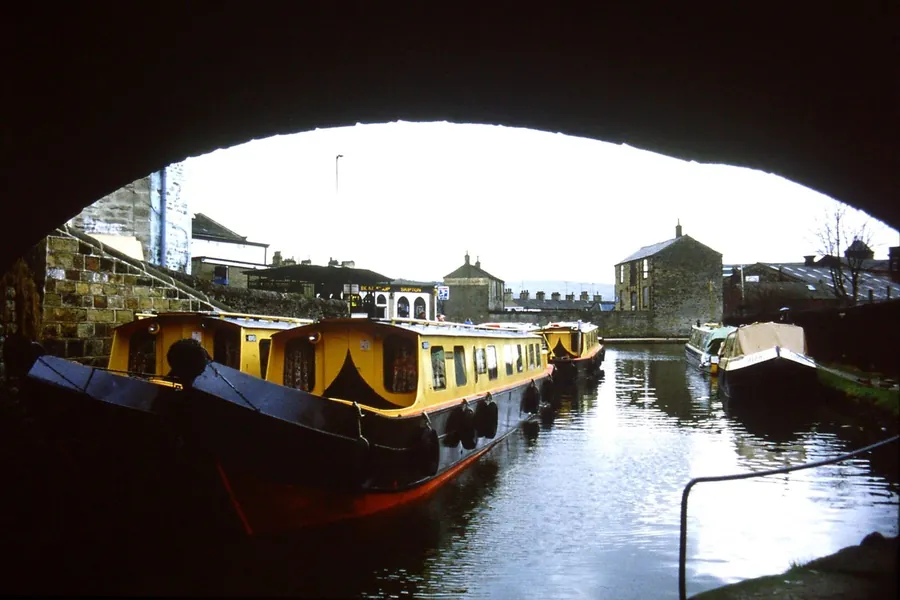
Burscough is three places layered on top of each other. The oldest is the canal village: the Leeds and Liverpool runs straight through the middle, and the wharf, the bridge and the terraces either side of it date from when the boats paid the bills. The Junction Lane conservation area and its Article 4 direction cover the heart of that. Roofs here are slate and brick-chimney, steep, and close enough together that a scaffold on one usually needs the neighbour’s agreement.
The second layer is the war. RNAS Burscough, commissioned as HMS Ringtail in 1943, put a Fleet Air Arm airfield on the flat land south-west of the village, and when it closed the hangars and the hard-standing went over to industry and farming. The houses that followed in the 1950s and 1960s were built for the people who worked there and in the town, and those are the roofs that are now coming up for their first full replacement: concrete interlocking tiles, often the early double-roman profile, on roofs with underlay that has gone brittle and torn under the battens.
The third layer is still being built. Yew Tree Farm on the northern edge is the biggest development the village has seen, and the estates that went up through the 1990s and 2000s off Liverpool Road North and towards Lathom are reaching the age where the first dry-verge clips are breaking and the first ridges are lifting. These roofs rarely leak dramatically. They lose a tile in a gale because the clip was never fitted, or the hip iron rusts through, and the job is a few hundred pounds if it is caught before water has been getting into the insulation for a year.
The moss under the house: peat, subsidence and flashings that open up
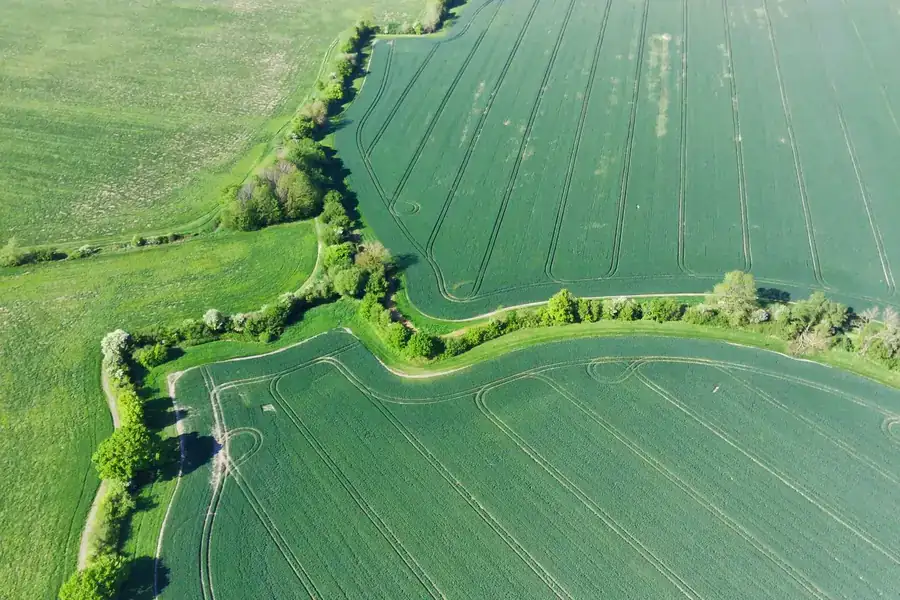
Everything west and north of Burscough, and most of the land between Ormskirk and the coast, used to be under water. Martin Mere was once the largest lake in England, until drainage schemes from the late seventeenth century onwards cut channels through it, and what was left is the moss - black peat, metres deep in places, now some of the best vegetable-growing land in the country.
Peat is a wonderful thing to farm and a poor thing to build on. Drained peat oxidises and shrinks, and it keeps doing so for as long as it stays drained, which is why the mossland roads undulate and why the older farmhouses and cottages out on it have moved. Not catastrophically, usually - but enough that a chimney stack on its own footing has settled at a different rate from the wall it sits in, and the lead flashing between them has been pulled open. Enough that a gable has leaned a few degrees and the verge mortar has cracked away along its full length. Enough that an outhouse roof now drains the wrong way.
We are honest with people about this because it is easy to sell a roof repair that will not hold. A flashing re-dressed tight against a stack that is still moving will open again. The right job is a flashing with movement built in - a proper stepped and cover-flashed detail with enough lap to take another decade of creep - and a frank conversation about whether the stack itself needs rebuilding or, if it is redundant, taking down below the roofline. If the crack in the brickwork is growing, that is a job for a structural engineer before it is a job for a roofer, and we will say so.
Scaffolding where the lorries cannot go
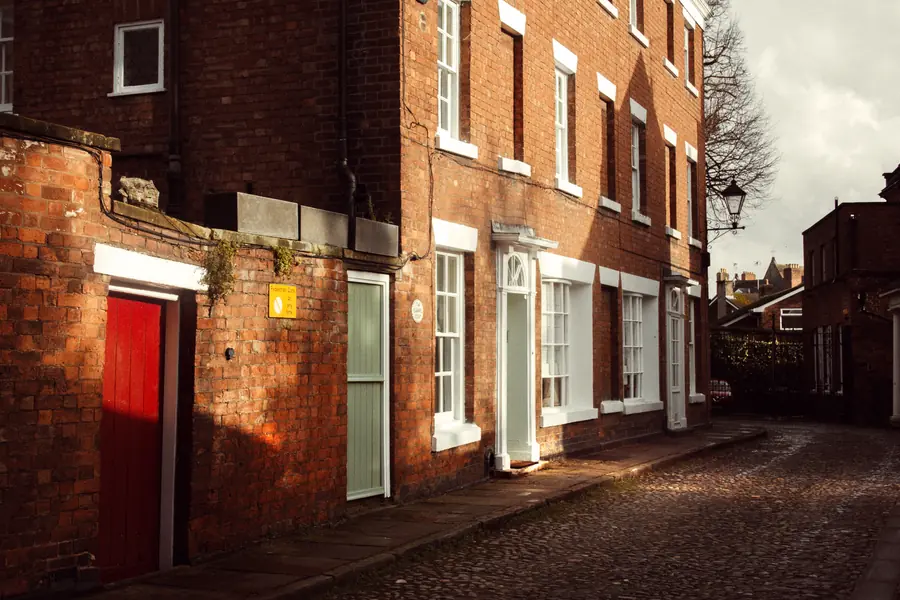
Ormskirk’s centre is pedestrianised, and on market days - Thursday and Saturday - it fills with stalls from the clock tower outwards. Church Street, Burscough Street, Moor Street and Aughton Street are narrow, the frontages are tall, and the back lanes behind them are often the only way to get a van anywhere near the roof. Getting a scaffold up on a three-storey town-centre property takes some working out.
Because the roads are Lancashire County Council’s rather than the borough’s, the licence to put a scaffold on the pavement comes from the county’s street works team at Preston, not from Derby Street. Lancashire County Council’s scaffolding and hoarding licence page sets out the terms: two working days’ notice, public liability cover of at least £5 million, and a fee of £42 for each seven days. If the scaffold will push pedestrians into the road, a traffic management plan has to go in with the application. In the pedestrian zone the question is less about traffic than about the market, and the sensible approach is to time the lift for a Monday to Wednesday and have the scaffold footprint agreed with the market office before the first standard goes up.
Outside the centre it is simpler. The terraces have back alleys, the interwar semis have driveways, and the estates have front gardens that take a tower without fuss. We covered the general choice between scaffold, tower and ladder elsewhere; the Ormskirk-specific point is that on a tall centre frontage the access can be a third of the invoice, and a quote that does not show it as its own line is a quote that has not thought about it.
The price of the drive from Southport
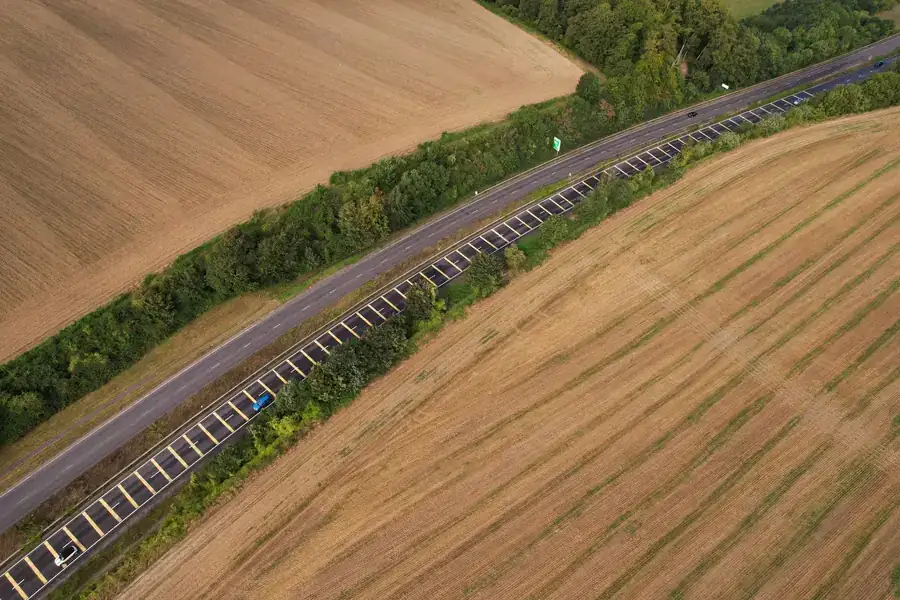
People in Ormskirk sometimes assume that a firm based in Birkdale will either charge them for the journey or not bother coming. Neither is true, and the reason is dull: the A570 is a road we are on most working days anyway. Scarisbrick is on the way, Burscough is ten minutes past the bypass, Aughton is on the far side of town, and a van that has done one of them in the morning is in Ormskirk for the afternoon at no extra cost to anyone.
So the prices are the same as they are at the coast. A single-fault repair - a slipped slate, a cracked flashing, a broken tile, a blocked outlet - runs £150 to £800 depending on what it takes to reach. Chimney work on the tall town-centre stacks is £400 to £1,300 including access. Gutter clearing and repairs sit between £90 and £350. A full strip and re-slate of a Victorian terrace is a five-figure job wherever it is, and in a conservation area the slate specification is the thing that moves the price, not the postcode.
What does differ is what we expect to find. Inland, the fault is usually one thing and it is usually old, and the quote is usually smaller than the customer feared. On the coast it is more often three things at once and the salt has got into all of them. If you are reading this in Ormskirk or Burscough with a damp patch on the ceiling, the odds are in your favour.
Frequently Asked Questions
Which council deals with my roof if I live in Ormskirk or Burscough?
West Lancashire Borough Council, for both planning and building control. Neither town has anything to do with Sefton, which stops at the Southport boundary near Scarisbrick. Roads, pavements and anything placed on them - a scaffold, a skip - are a separate matter again and sit with Lancashire County Council as highway authority. If a roofer talks to you about Sefton's rules for an Ormskirk house, they have not looked at a map.
Do I need planning permission to re-roof a house in Ormskirk town centre?
If the house is inside the Ormskirk Town Centre conservation area, and the roof slope or chimney faces the street, quite possibly yes. That area carries an Article 4(2) direction, which removes the usual permitted development rights for alterations to roofs and chimneys on elevations facing a highway, including a change of material. Slate back on in place of slate is still maintenance and needs nothing. Concrete tiles in place of slate, or losing a front chimney, is an application. Ruff Lane in Ormskirk and Junction Lane in Burscough have the same direction.
Is a roof repair in Ormskirk more expensive than the same job in Southport?
No. Our prices in Ormskirk, Aughton and Burscough sit in the same bands as Southport - single-fault repairs typically £150 to £800, chimney work £400 to £1,300 with access, gutter clearing and repairs £90 to £350. The A570 is a road we drive most days, so there is no travel surcharge to pass on. What does change the figure is the building: a steep three-storey frontage on Burscough Street costs more to reach safely than a bungalow in Aughton, and that shows on the quote as an access line rather than a town premium.
My farmhouse out on the moss has gaps opening up at the chimney flashing. Why?
Almost certainly ground movement rather than roof failure. The West Lancashire mossland is drained peat, and drained peat shrinks and settles for decades, often unevenly under different parts of the same building. A chimney stack founded on a different footing to the walls around it moves at a different rate, and the lead flashing between them is the first thing to show it. The fix is usually to re-dress the flashing with enough movement built in, and to watch the brickwork. If the gap keeps growing, you need a structural engineer before you need us.
Free Roof Survey & Quote
Free roof survey and a fixed written quote, anywhere across Southport, Sefton and West Lancashire.