
6 October 2026
Lead Flashing And Valleys On Southport's Victorian And Edwardian Villas
Where the lead sits on a Southport villa roof, why it splits, lifts and stains, what the Lead Sheet Association guidance says, and when GRP or a lead substitute makes sense.
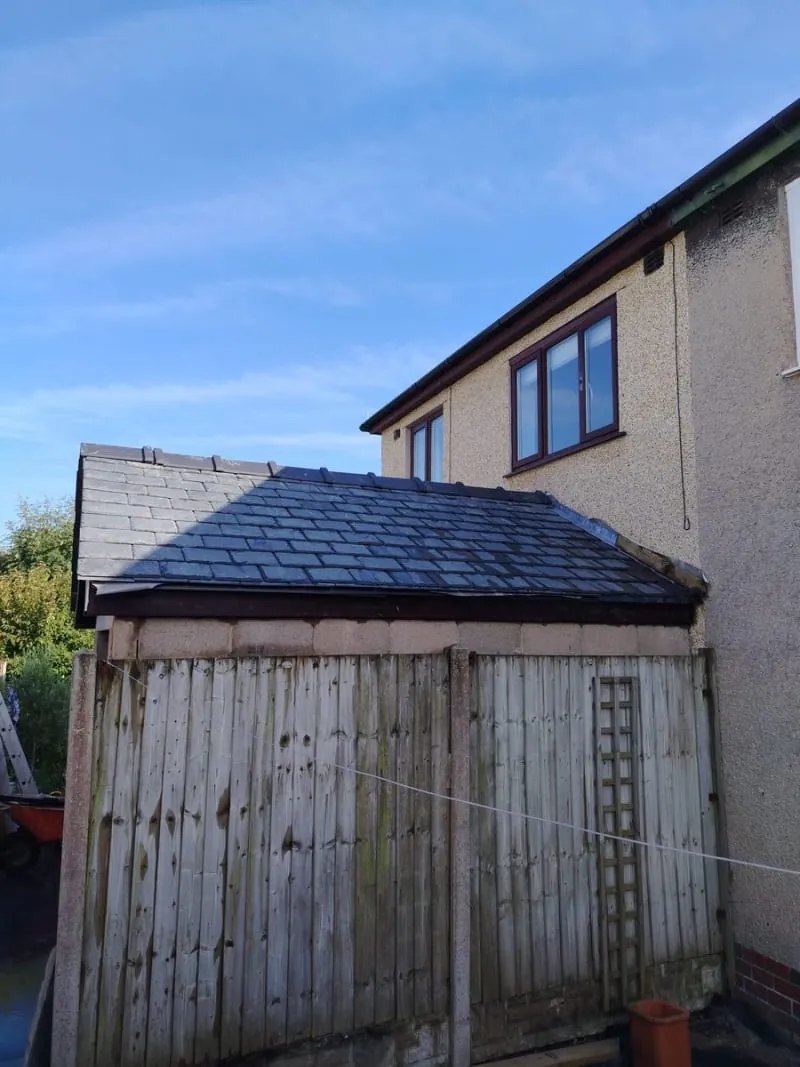
On the big old houses we get called to in Southport, the leak is far more often at the lead than in the slates. A big Victorian or Edwardian house around Birkdale Park, Hesketh Park or the streets behind the Promenade can easily have a dozen or more separate bits of lead: round the chimneys, up the sides of every gable that butts against a taller wall, down each valley, across the bays, and on the cheeks of the dormers in the attic storey. The slates themselves are often a hundred years old and still sound. The lead has had a harder time of it. It sits at every joint where one surface meets another, and here those joints take the wind straight off the Irish Sea, with salt and fine sand in it. This guide goes through where the lead is on a typical Southport villa, the ways lead flashing and valleys fail, what the trade guidance actually says, and when a substitute is worth considering.
A walk round the lead on one Southport villa
Start at the chimney, because that’s where everyone looks first. Every stack needs a lead apron across the front, stepped flashings with soakers up each side and a small back gutter on the uphill side to turn water round it. We covered stacks in detail in our guide to chimney leaks and repointing in Southport, so here it is enough to say they are only one of several lead jobs on the roof.
Next come the abutments. A villa built in stages, with a two-storey back addition, a lower kitchen wing or a lean-to like the one in the photo above, has a sloping roof running into a vertical wall in several places. Each of those joins is sealed with a stepped flashing let into the brick joints, cut so that it follows the slope down the wall in a staircase of small steps.
Then there are the valleys. Wherever two slopes meet in an internal corner, such as a front gable meeting the main roof or a back wing joining the house, there is a lead-lined channel carrying the water from both. On a double-fronted house with gabled bays you can count four or five valleys without going round the back.
Last come the small pieces: the lead flat or apron over a bay, the cheeks and tops of dormers, the soakers hidden under the slates at every side abutment. Small pieces, every one of them a possible leak. If you’ve got a stain on a ceiling and can’t work out where it’s coming from, our roof leak repairs in Southport page explains how we trace it back.
Valleys: two roofs’ worth of water in one channel

From the street a valley looks like a shallow grey crease. Underneath, a traditional lead valley is a timber valley board laid between the rafters, with tilting fillets either side to lift the edges of the slates, and a lining of Code 4 or Code 5 lead dressed into the channel. The slates on both slopes overhang the lead and are cut to a line, leaving an open gutter down the middle.
The Lead Sheet Association’s guidance, set out in its manual Rolled Lead Sheet: The Complete Manual, is specific about how this should go together. Each piece of valley lining is no more than 1.5 metres long. It is fixed across the top only, with two rows of copper or stainless steel nails, and never down the sides. Pieces overlap by 150mm on a roof pitched at 30 degrees or more, increasing to 220mm as the pitch drops towards 20 degrees. No bituminous felt goes underneath, because it softens in summer and glues the lead to the board.
Southport valleys pick up an extra load that inland ones don’t. Sand blown off the dunes settles in the channel, mixes with moss and forms a damp mat that holds water against the lead and the cut slate edges. It also slows the run-off enough for a heavy downpour to back up over the edge of the lining. So a valley that leaks only in long, heavy rain is not necessarily split. It may simply be choked.
Why lead splits: length, fixings and a hot afternoon
Lead moves with temperature more than almost anything else on a roof. A strip warmed by an afternoon of sun on a west-facing slope grows a little, and shrinks again when the evening breeze comes in off the sea. A piece that is free to slide copes with that indefinitely. A piece that is pinned at both ends, or simply too long, can’t, and the stress gathers at folds and fixing points until the metal tires and cracks.
That is why the 1.5 metre limit matters. On older Southport roofs we regularly find valleys lined in lengths of two and a half or three metres, or abutment flashings run along a whole wall in one piece. They often look fine from below. Up close there is a hairline crack across the sheet, usually just below a nail or along a crease, and it lets in a steady trickle every time it rains.
Thickness counts too. Code 4 lead is 1.8mm thick and Code 5 is 2.24mm. Code 3, at 1.32mm, is fine for soakers hidden under slates but too thin for anything exposed. Old repairs done with whatever was left on the van tend to fail first. And an old repair covered in bitumen paint or flashing tape almost always means somebody found a crack and covered it over without fixing what made it crack in the first place.
Onshore wind, wedges and the pointing that lets go

The other way lead fails here is by lifting. A flashing is held in two ways: the top edge is turned at least 25mm into a mortar joint and wedged, and the bottom edge, which lies over the slates, is held down by clips. When the wind gets under that free edge it pulls on both. If the clips are missing or too far apart, the lead lifts, flaps and bends back, and before long the turn-in is pulled out of the joint.
The guidance calls for fixings at about 450mm centres along a horizontal cover flashing, at every single step on a stepped one, and clips at the lower edge spaced to suit the exposure. That means tighter spacing on a roof facing the beach than on one in a sheltered back street. Clips should be copper or stainless steel. Galvanised fixings rust quickly in Southport’s salty air, as does anything else made of ordinary steel. We went into why the coast’s wind loads are taken so seriously in our post on wind uplift and BS 5534 fixing in Southport, and the same reasoning applies to lead.
Then there is the pointing. Most old flashings were pointed in with sand and cement. It looks tidy for a few years, but mortar doesn’t stick well to lead, and as the metal moves the mortar cracks along the joint and drops out in small pieces. Once it has gone, rain runs straight down the back of the flashing. The Lead Sheet Association recommends a lead sealant for pointing instead, because it stays flexible. If you can see daylight between your flashing and the brickwork from a ladder, that’s the place to start.
White streaks and the oil that stops them
New lead is bright and silvery. Over its first months outdoors it builds up a dull grey patina that protects it for decades. The trouble is the first few weeks. Rain on fresh lead forms lead carbonate, a powdery white coating that washes off and leaves chalky streaks down slates, render and painted sills. On a cream-rendered Birkdale frontage it shows from the pavement.
Patination oil prevents most of it. It is wiped on in a single thin coat on the day the lead goes in, before any rain, including a strip on the underside of the edges and between the laps. That takes a few minutes per detail and costs very little. A roofer who skips it hasn’t made the roof leak, but they have left you with marks that take a long time to fade, and that tells you something about how carefully they work.
If the streaks are already there, they will fade as the lead patinates and the weather cleans the surfaces below. Scrubbing hard at stained render often makes things worse.
Lead, GRP or a lead substitute?

You do have options besides lead. Preformed GRP valley troughs drop into place in long lengths, have no scrap value and need no specialist leadwork. Flexible lead substitutes, usually a polymer or a rubber-type material with a mesh or aluminium core, are used for flashings and are increasingly common on new builds and extensions.
We fit them ourselves where they suit. On a 1990s extension, a dormer that nobody sees from the road or a garage roof, a good-quality substitute fitted properly is a reasonable choice, and on a house that has already had lead stolen it can be the sensible one. Fitting still matters. A GRP valley with poorly cut slates or no tilting fillets will leak just as quickly as a badly laid lead one.
On a period villa we lean towards lead, for two reasons. The first is how it looks. Lord Street, the Promenade, Birkdale Park, West Birkdale and Hesketh Road are all among Sefton’s designated conservation areas. Swapping like for like doesn’t need permission, but a bright plastic trough in the front valley of a slate roof is a visible change, and on a listed building changing the material can need consent. The second is that most lead valleys we strip out didn’t fail because lead is a poor material. They failed because the pieces were too long or nailed down the sides. Re-laying in lead to the right lengths fixes that. Our job-by-job guide to roof repair costs in Southport gives typical prices for relining a valley and renewing chimney lead.
Lead theft and how to make your roof a poor target

Lead is worth stealing, and a big house with a long run of lead valleys and flats carries a fair weight of it. Churches and commercial buildings get the headlines, but houses get hit too, especially empty ones, houses with scaffolding left standing over a weekend, and low roofs you can reach from a garden wall.
The law has made it harder to sell. Under section 12 of the Scrap Metal Dealers Act 2013, a dealer can no longer pay cash for scrap metal, only by non-transferable cheque or electronic transfer, so the seller leaves a record behind. That has cut down the casual trade. It hasn’t stopped it.
The practical steps are simple. Don’t leave scaffolding up longer than the job needs, and ask your roofer to take off or board over the bottom lift when nobody is on site. Keep wheelie bins and ladders away from walls that lead up to low roofs. A camera or a motion-sensor light at the back of the house puts off someone working at night. If lead has been stolen, photograph the roof, report it to the police for a crime reference and speak to your insurer before work starts, because policies differ on how they treat metal theft. Our storm and insurance guide covers how to put that kind of claim together.
Whatever is on your roof now, a close look from a ladder or a camera pole will show more than any amount of guessing from the garden. Book a free lead and valley inspection in Southport
Frequently Asked Questions
How long should lead flashing last on a Southport house?
Properly laid lead will normally outlive the slates around it. When it fails early on a Southport roof, the cause is nearly always the way it was put on rather than the metal itself: pieces cut too long, nailed down the sides so they can't move, wedged too far apart, or pointed in with mortar that cracked away. Fix the method and the material looks after itself.
What is the maximum length for a piece of lead flashing?
Guidance from the Lead Sheet Association, which follows BS 6915, caps flashings and pitched valley linings in Code 4 or Code 5 lead at 1.5 metres per piece. Soakers in Code 3 should be no longer than a metre. Pieces join with a lap of at least 100mm on flashings and 150mm or more in a valley, and that lap is what gives the lead room to expand and contract.
Is a GRP valley as good as a lead one?
A preformed GRP valley trough is quick to fit, has no scrap value and suits plenty of later houses and extensions. On a slate roof inside one of Southport's conservation areas, or on a listed building, lead is the expected material and a plastic-looking trough can stand out. If the existing lead valley only failed because it was laid in over-long pieces, relining it properly in lead is usually the better repair.
Why is there white staining running down from my new lead?
That is lead carbonate. New lead reacts with rain and the air for its first few weeks and the chalky white residue washes down onto slates, render and windowsills. Patination oil applied on the day of fitting, before the first shower, stops most of it forming. If you have the streaks, the lead was not oiled or was rained on before it could be.
Free Roof Survey & Quote
Free roof survey and a fixed written quote, anywhere across Southport, Sefton and West Lancashire.